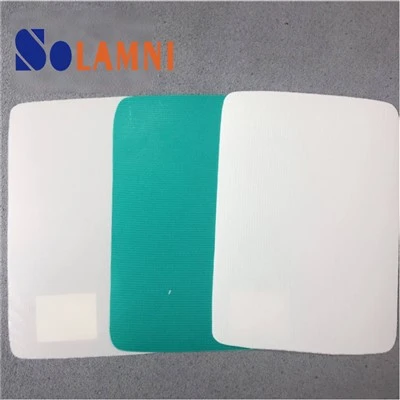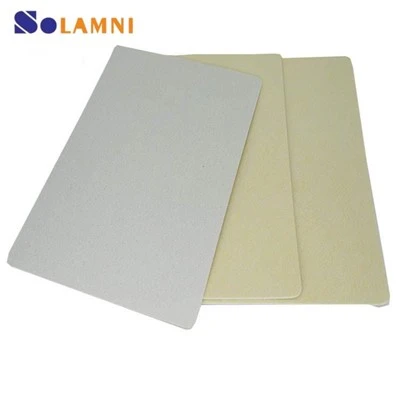


Industrial-Grade Chemical-Resistant Sheet (Solamni) is a durable, non-woven composite material manufactured from polyester fibers, styrene acrylic binder, and starch.
Product Specifications
|
Item |
Specification |
|
Material Composition |
65% Polyester Fiber + 15% Styrene Acrylic Lotion + 20% Starch Binder |
|
Thickness Range |
0.6–1.5 mm (Tolerance ±0.05 mm) |
|
Sheet Size |
1.0 × 1.5 m; Width options: 1.37 m / 1.40 m |
|
Mechanical Performance |
Tear-Resistant, Shrink-Resistant, Stable under processing conditions |
|
Functional Properties |
Waterproof, Breathable, Anti-Static, Anti-Bacterial |
|
Surface & Color |
Customized colors available for different applications |
|
Format Options |
Flat Sheets and Continuous Rolls Available |
|
MOQ |
1,000 Sheets |
|
Origin |
Quanzhou, Fujian, China |

Technical Performance
Thermal Stability: Retains dimensional integrity from -20°C to 90°C to prevent panel warping during high-heat processing.
Moisture Resistance: Water absorption rate below 0.2% after 24-hour immersion; retains structural rigidity above 85% RH.
Flex Endurance: Tested to SATRA TM55 standards to prevent surface cracking during repeated dynamic flexing.
Chemical Stability: 20% starch binder is chemically cross-linked and encapsulated by the styrene-acrylic lotion, preventing starch hydrolysis and ensuring long-term stability across a pH 2–12 environment.
Footwear & Industrial Applications
Safety & Athletic Footwear: Structural insole boards engineered for oil resistance and puncture protection in heavy-duty work boots and outdoor footwear.
Automotive Interior Panels: Dimensional reinforcement inserts for door trims and trunk liners, resisting sag under summer cabin temperatures.
Luggage & Protective Gear: Rigid internal stiffeners for suitcases and tool bags, providing impact absorption and abrasion protection.
Industrial Spacer Gaskets: Fluid-resistant spacer gaskets for light chemical processing equipment and protective boot insoles.
Manufacturing Process
Fiber Preparation: Carding and cross-lapping polyester fibers into a non-woven web with precise basis weight control.
Resin Impregnation: Fully saturating the matrix with styrene-acrylic emulsion to lock internal bond strength.
Thermal Drying: Evaporating moisture via multi-stage temperature zones to freeze resin distribution before pressing.
Calendering: Compressing the sheet through heated precision rollers to lock in ±0.05mm thickness tolerance.
Curing & Slitting: Thermally cross-linking binders for dimensional stability and slitting into custom sheets or continuous rolls.
Packaging & Global Supply
Minimum Order Quantity: Standard MOQ begins at 1,000 sheets per customized specification.
Export Packaging: ISPM 15-compliant fumigated wooden pallets, vacuum-sealed with multi-layer moisture-proof PE film.
Lead Time & Port: Standard orders shipped within 7 to 14 calendar days FOB Quanzhou Port, China.
Payment Terms: Standard T/T (30% deposit, 70% balance against B/L copy) or Irrevocable L/C at sight.
Export Documentation: Full FCL/LCL logistics management including MSDS, COA, Certificate of Origin, and Form E.


FAQ
Q: Does the 130-150°C thermoforming range affect the material's -20°C to 90°C continuous operating temperature rating?
A: No, the 130-150°C range applies only during factory hot-press bonding and shaping; once formed and cooled, the finished component's continuous service temperature range remains -20°C to 90°C.
Q: When should buyers choose flame lamination versus adhesive lamination?
A: Flame lamination is recommended for higher-temperature technical textiles requiring a more permanent, chemical-free bond, while adhesive lamination suits lower-temperature-sensitive fabrics or applications requiring a more flexible, peelable bond line.
Q: What pH range or specific chemicals has this material been verified for?
A: This material has been verified per ASTM D543 against common industrial acids and alkalis in the pH 2-12 range, including dilute sulfuric acid and sodium hydroxide solutions.
Q: What happens if a batch fails the tensile strength or chemical resistance test after arrival at the destination port?
A: Buyers must submit a claim with test evidence within 15 days of port arrival, after which a credit note or free replacement is issued within 10 business days upon verification.
Q: What thickness is recommended for automotive door trim reinforcement versus chemical containment gaskets?
A: Automotive door trim inserts typically use 0.8- 1.2 mm for rigidity without excess weight, while chemical containment gaskets and sealing sheets use 1.0-1.5mm.
Hot Tags: industrial-grade chemical resistant sheet, China industrial-grade chemical resistant sheet manufacturers, factory